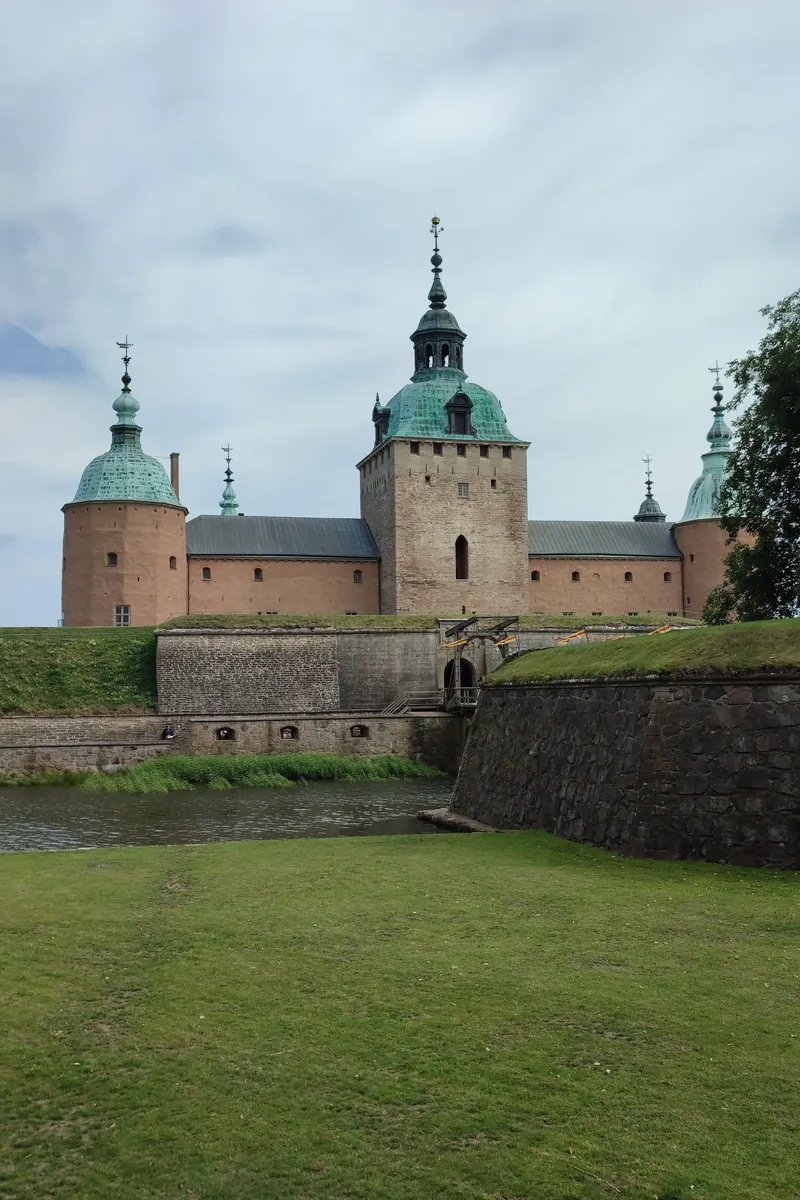
Step into Sweden's finest Renaissance palace
Ringed by seawater and eight centuries of history, Kalmar Slott is where the Kalmar Union was sealed in 1397 and where the Vasa kings later built one of Scandinavia's most lavish royal courts. This is the fortress that guarded Sweden's south-east coast — and the palace that became its most beautiful.
See royal gardens near Kalmar- 1397 Where the Kalmar Union uniting Sweden, Norway and Denmark was signed
- c.1180 Origins as a defensive tower guarding the Kalmar strait
- 3 kings Rebuilt into a Renaissance palace by Gustav I, Erik XIV and Johan III
- Best-preserved Regarded as the best-preserved Renaissance castle in the Nordic countries
Tours and experiences near Kalmar Castle
Compare the best-rated ways to explore the area, check live availability and book in a few taps.
- Top pick
Öland: Solliden Palace Gardens Entry Ticket
An entry ticket to the gardens of Solliden Palace on Öland, the Swedish royal family's summer home, a short drive over the bridge from Kalmar.
From US$15Check availability ↗ Öland: Solliden Palace Gardens Guided Tour
A 45-minute guided walk through the Solliden Palace gardens on Öland, led in Swedish, with garden entry.
From US$15Check availability ↗
More things to do nearby
About Kalmar Castle
Kalmar Castle stands on a small island at the mouth of the Kalmar strait, on Sweden's south-east coast facing the island of Öland. Its origins reach back to around 1180, when a round defensive tower was raised to guard this strategic stretch of the Baltic. During the 13th century it grew into a proper fortress with a ring wall and round corner towers — the castle's own history credits King Magnus Ladulås in the later 1200s, while the national property board dates the expansion earlier, so the attribution is not settled. In 1397 that fortress hosted one of the most consequential meetings in Scandinavian history, when the Kalmar Union bound Sweden, Norway and Denmark under a single crown.
The castle's true transformation came in the 16th century, when Gustav I Vasa and his sons Erik XIV and Johan III rebuilt the grim medieval stronghold into a Renaissance palace fit for a royal court. Under Johan III, work from 1574 gave the towers their uniform height and reshaped the windows and façades, while inside, craftsmen created rooms that still rank among the finest Renaissance interiors in Northern Europe — the coffered, gold-leafed ceiling of the Golden Hall, the carved wooden inlay of the Checkered Hall, and the intimacy of the Queen's Suite and the King's Chamber, whose ceiling carries the date 1562.
Today Kalmar Castle runs as a museum drawing roughly 190,000 visitors a year, its Renaissance halls sitting alongside a dungeon in the castle's prison tower and, in summer, a dedicated 'Children's Castle' programme that turns the fortress into an adventure for younger visitors.
Practical information
- Opening hours
- Opening days and hours both vary by season, and the castle is not open daily year-round. In 2026, peak summer (22 June–9 August) runs 10:00–18:00 daily; 1–21 June and 10–30 August run 10:00–17:00; the rest of the daily season (26 March–31 May and 31 August–1 November) runs 10:00–16:00. Winter, late autumn and December run 11:00–15:00 — daily over the Christmas and New Year period and in the February school-break week, but on selected days only at other times (Thursday–Sunday, or weekends), with several multi-day gaps between periods. The castle is closed on New Year's Day, and Midsummer's Eve closes early (10:00–14:00).
- Address
- Kungsgatan 1, 392 33 Kalmar, Sweden.
- Getting there
- Kalmar Castle sits a short walk from the bus and train stops at Kalmar Central Station — about 750 metres, roughly a 10-minute walk, through the castle park. Kalmar is reached from Stockholm by train in around 4.5 hours (at least one change, usually at Alvesta), and from Copenhagen in around 3.5 hours, with most Öresundståg services running direct.
- Accessibility
- Ground-floor courtyard areas and parts of the Renaissance state rooms are accessible, but the older fortifications and tower stairways involve uneven stone floors, steps and narrow spiral staircases that are not step-free. Wheelchair users and visitors with limited mobility should contact the castle ahead of a visit to confirm which routes and rooms are reachable.
- Bag policy
- Large backpacks and suitcases are best left at your accommodation — the castle's older stairways and passages are narrow, and the castle does not advertise a left-luggage service at the entrance.
- Photography
- Personal, non-commercial photography is generally welcome; flash and tripods may be restricted in some rooms to protect the historic Renaissance decoration, and signage on site will tell you where.
Plan your visit
Practical guides written by our travel team
Best Time to Visit Kalmar Castle
Which days the castle is actually open in 2026, which season suits you, and how long to allow — a timing guide to the Nordic region's best-preserved Renaissance castle.
Getting to Kalmar Castle from Stockholm or Copenhagen
Mostly direct from Copenhagen, one change at Alvesta from Stockholm, and 750 metres on foot at the far end — how to reach Kalmar Castle by rail, air and road.
Visiting Kalmar Castle with Kids
A summer Children's Castle with knight duels, year-round activity trails, and a set of practical rules worth knowing before you arrive — how to plan a family day at Kalmar Castle.
Frequently asked
How do I get to Kalmar Castle?
The castle is a walkable 750 metres, about 10 minutes, from Kalmar's city centre and railway station, through the castle park. From Stockholm it's around 4.5 hours by train with one change; from Copenhagen it's a direct train of around 3.5 hours.
How long does a visit take?
Most visitors spend two to three hours exploring the state rooms, the fortifications and the castle's prison tower — longer if the Golden Hall or the Children's Castle programme particularly interest you. There's no fixed schedule, so you set the pace.
Is Kalmar Castle good for children?
Yes. In summer the castle runs a dedicated 'Children's Castle' programme, and the mix of towers, ramparts and a real dungeon in the castle's prison tower tends to capture children's imaginations year-round. The older stairways are narrow, so keep younger children close.
Is the castle accessible for visitors with limited mobility?
Partially. Ground-floor courtyard areas and parts of the Renaissance state rooms are generally accessible, but the older fortifications and tower stairways have uneven stone floors and narrow spiral staircases that are not step-free. Contact the castle ahead of your visit to plan a suitable route.
Can I take photos inside the castle?
Yes, personal photography is generally welcome. Flash and tripods may be restricted in a few rooms to protect the historic Renaissance decoration, and signage on site will tell you where that applies.
What is the Kalmar Union, and why did it happen here?
In 1397, representatives of Sweden, Norway and Denmark met at Kalmar Castle to unite the three kingdoms under a single crown — the Kalmar Union, organised by Queen Margaret I of Denmark. It's one of the pivotal events in Scandinavian history, and it happened inside this castle.
What is the Golden Hall?
The Golden Hall (Gyllene salen) is Kalmar Castle's grandest Renaissance room. Its coffered ceiling is described by the castle as one of the best-preserved 16th-century examples in the Nordic countries — a highlight of any visit.
How does booking work on this site?
This site is an independent visitor guide to Kalmar Castle. When you choose a tour or experience, you book it directly with GetYourGuide, which takes the payment, confirms the booking and handles any changes or cancellations. We may earn a commission when you book, at no extra cost to you.